In traditional technique-based training, the visible execution is often placed at the forefront. The student learns movements, sequences, or applications and tries to replicate them as accurately as possible. This can be useful in the beginning, as form provides orientation and establishes an initial external structure. It only becomes problematic when this outer form is mistaken for the actual content. At that point, one merely reproduces what is visible, without understanding the underlying internal logic, spatial organization, and functional idea.
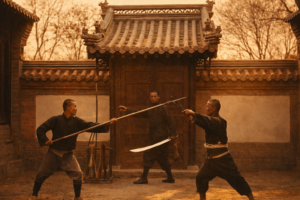
In a systemic understanding of martial arts, Xing, form, kata, and partner applications therefore take on a different role. Form is not the goal, but a means. Through form, one can explore planes, circles, directions, angles, vectors, and transitions—both in solo practice, such as standing and circle walking, and in partner work. In this way, form becomes a kind of laboratory in which the fundamental grammar of movement becomes visible and experiential. What is crucial, however, is that these principles are explained and made tangible. Without proper guidance, beginners usually only perceive the external shape and imitate arm positions, steps, or turns without recognizing the internal structure. They see the form, but not the principle; they repeat the movement, but not the idea.
Working with circles, planes, and directions does not only change the understanding of movement, but also transforms one’s bodily perception. The practitioner learns to no longer use the body as a collection of separate limbs, but to perceive it as an interconnected, spatially organized whole. They begin to feel how forces align within the body, how rotations emerge, how planes are coupled, how vectors travel through the body, and how structure develops in space. In this way, the perception of one’s own body becomes more refined: balance, connection, direction, tension, relaxation, and transition become clearer, more differentiated, and more conscious. This goes beyond technique training—it is a training of body organization.
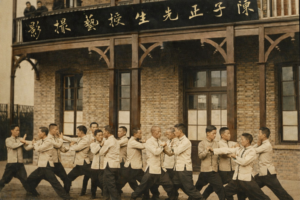
Yi then enters as the governing instance. Once form and bodywork have developed the internal grammar and the appropriate bodily feeling, Yi can make functional use of all of it. Yi gives direction, meaning, and intention to the structure. It determines which plane is emphasized, in which direction the vector moves, which circle is opened or closed, how one responds to a partner, and which quality is required in a given moment. Only then does bodywork become living application. Without Yi, structure remains passive; with Yi, it becomes capable of action.
This creates a fundamentally different learning model compared to mere technique training. Technique is no longer the starting point, but only the visible expression of a deeper system. Form helps reveal the grammar of movement. Bodywork makes this grammar tangible within one’s own body and refines bodily perception. Yi ultimately connects both and turns them into functional, applicable action.
Through Xing, kata, or forms, planes, circles, and vectors become visible.
Through bodywork, they become tangible within one’s own body.
Through Yi, they are finally applied in a meaningful way.
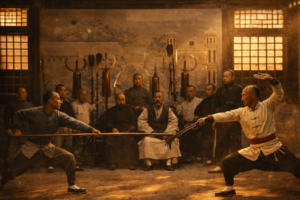
In this understanding, the transmitted applications, with or without weapons, are far more than a catalog of old techniques. On the one hand, they serve as concrete templates through which the grammar of movement can be studied: planes, circles, directions, vectors, transitions, distance, and functional body organization all become visible within them. On the other hand, especially in the beginning, they are important tools for developing practical self-protection. They provide the practitioner early on with usable, structured, and time-tested patterns of action. Thus, they function both as practical means of defense and as didactic keys. As understanding deepens, they are not discarded, but read on a deeper level: first as technique, then as principle, and finally as the expression of a living system.
Yi training not only refines the control of the body, but also deepens an embodied understanding of the world. It develops the ability to perceive the essence of things, forces, and relationships, and to make them effective within one’s own body and mind.
Martial arts are not primarily a system of techniques, but a learning path in which the practitioner first recognizes the grammar of movement, then embodies it through bodywork, and finally applies it functionally, dynamically, and appropriately through Yi. Forms and applications serve as didactic templates and practical tools, but must never be mistaken for the essence itself. The essence does not lie in the outer form, but in the perception and organization of structure, quality, relationship, and meaning—within one’s own body, in interaction with others, and in the world.

