Hardly any sentence is so pleasantly vague. It sounds like discipline, bodily control, and a slightly exotic boost to one’s self-image. It signals depth without demanding details. Above all, it spares us an uncomfortable question: what this martial art was actually meant for in the first place.
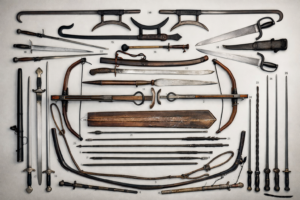
Historically speaking, martial arts were neither aesthetic movement systems nor educational programs. They were tools. And tools do not arise from philosophical curiosity but from necessity. Martial arts emerged in a world where violence was not an abstract possibility but a recurring reality. Military conflicts, political instability, organized crime, personal protection—these were not exceptional situations but normal conditions. Martial arts were responses to them. Practical, functional, often brutal, and rarely romantic.
What matters is not the technical differences between individual systems but their purpose. Historical martial arts were not concerned with beauty, fairness, or moral exemplarity. They were concerned with function. And that function varied greatly depending on context. Systems for bodyguarding and personal protection prioritized control, positional work, and operating in confined spaces, often with multiple actors and under the threat of weapons. Military systems emphasized efficiency, breakthrough, and neutralization—not to impress, but to remain operational. Urban violence milieus, in turn, favored strategies of deterrence, rapid escalation, and clear dominance. What all these systems shared was an instrumental understanding of violence: as a means to an end, not as a pedagogical problem.
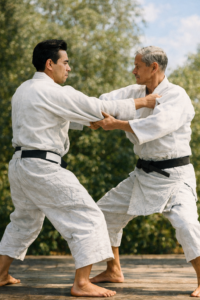
That this idea makes us uncomfortable today says more about our societal development than about the martial arts themselves. As the state increasingly monopolized and regulated violence, the framework in which martial arts could exist also shifted. Modern weapons rendered many traditional close-combat systems militarily secondary, but culturally highly interesting. They were not abolished, but reinterpreted. Especially in China and Japan, they found their way into national education programs. Martial arts were now meant to shape bodies, instill discipline, and foster identity. Violence was not eliminated, but linguistically softened. Where once one spoke of control or neutralization, one now spoke of character development, harmony, or self-cultivation.
This development was socially sensible and politically successful. But it came at a price. Techniques were standardized, dangerous content defused, weapons pushed out of regular training or treated only symbolically. Martial arts were civilized—and with them, their self-understanding. With the advent of sportification, the original purpose was finally lost from view. Competitions made martial arts comparable, safe, and media-friendly. They created rules, weight classes, and clear conditions for victory. What they did not do was carry along the original context of violence.
Rules are not a side issue. They define purpose. A competition does not ask how a threat is ended, but who prevails within a clearly limited framework. That is legitimate—but fundamentally different. A system optimized for sporting success necessarily trains different abilities than one designed for unpredictable violence. Anyone who promises both at once is either engaging in creative marketing or confusing effect with function.
In this landscape, a term reliably appears to hold everything together: self-defense. It is the joker of modern martial culture. It sounds necessary, reasonable, and morally impeccable—and explains almost nothing. Self-defense does not describe a training system but a goal, and even that usually remains vague. Does it mean avoidance, control, escalation, or existential violence? Without context, everything remains open. That is precisely what makes the term so popular.
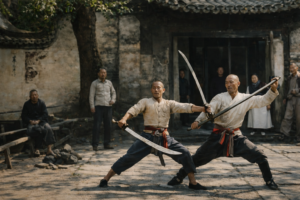
The real problem, however, lies deeper—in our contemporary relationship to violence itself. Many people no longer have a realistic image of violence. Socially, this is a success story. Functionally, it is a problem. For many, “extreme violence” already begins with a punch to the face. Emotionally and legally, that is correct. Practically speaking, however, it is only a very small slice of what violence can be.
Violence today is often imagined as an escalating dialogue: there are warning signs, threats, a confrontation, perhaps a scuffle. This notion shapes not only public debate but also training realities. What is largely excluded is another form of violence—one that does not argue, does not threaten, and does not escalate. It does not begin loudly, but suddenly. It does not seek confrontation, but opportunity. It is goal-oriented, cold, and non-reactive. For many people, this form of violence is barely imaginable—simply because they have never encountered it.
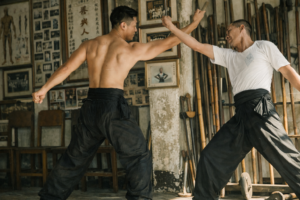
Modern martial arts practice is almost always based on a dialogical model of violence. Two actors recognize one another as interaction partners, respond to signals, test boundaries. Even aggressive scenarios remain cooperative. Historically speaking, this is a very specific form of violence. Many martial arts, however, were created for situations in which violence was not dialogical—not fair, not predictable, not mutual.
That many martial arts today are practiced by people with no contact to real violence is not an accusation. It is a fact—and a good one. It becomes problematic where this fact is not reflected upon. Training systems inevitably adapt to the experiential world of their practitioners. Content is softened, objectives shifted, risks minimized—not out of cowardice, but out of adaptation.
What gets lost are rarely techniques. What gets lost are decision logics: when violence begins, how early it is applied, how little it is announced, and how much it depends on taking initiative rather than reacting. These things cannot be replaced by technical drills if the mental frame of reference is missing.
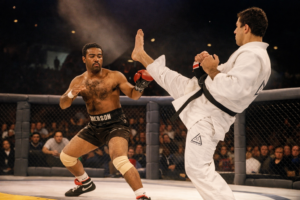
What follows from all this is not a moral reckoning, but a practical consequence. Martial arts are tools. And tools should be judged by what they are made for. Competition can be an excellent school for certain aspects of violence competence: stress resistance, decision-making under pressure, sense of distance, assertiveness. For dialogical, symmetrical forms of violence, it is often more honest than much of what calls itself “realistic.” It just does not do everything—and ideally does not claim to. We also wrote about this in the article “Training for what.”
The decisive question, therefore, is not how realistic a martial art is. Nor is it which style is the “real” one. The decisive question is: what exactly do I actually want to be able to do—and why? Do I want to test myself, challenge myself, preserve a lineage or tradition, develop myself, express myself? Or do I believe I am preparing for situations I neither know nor can realistically simulate? And does the tool I am using truly fit that goal—or do I simply like the story I am telling myself about it?
This question is uncomfortable because it destroys illusions. It is unpleasant because it returns responsibility. But it is more honest than any style debate, any invocation of tradition, or any marketing promise. Martial arts do not lose their value when they know their limits. They lose it where they deny those limits. For nothing is more misleading than a tool used with great conviction without ever having examined what it was actually made for—and whether one truly needs it for that purpose.

